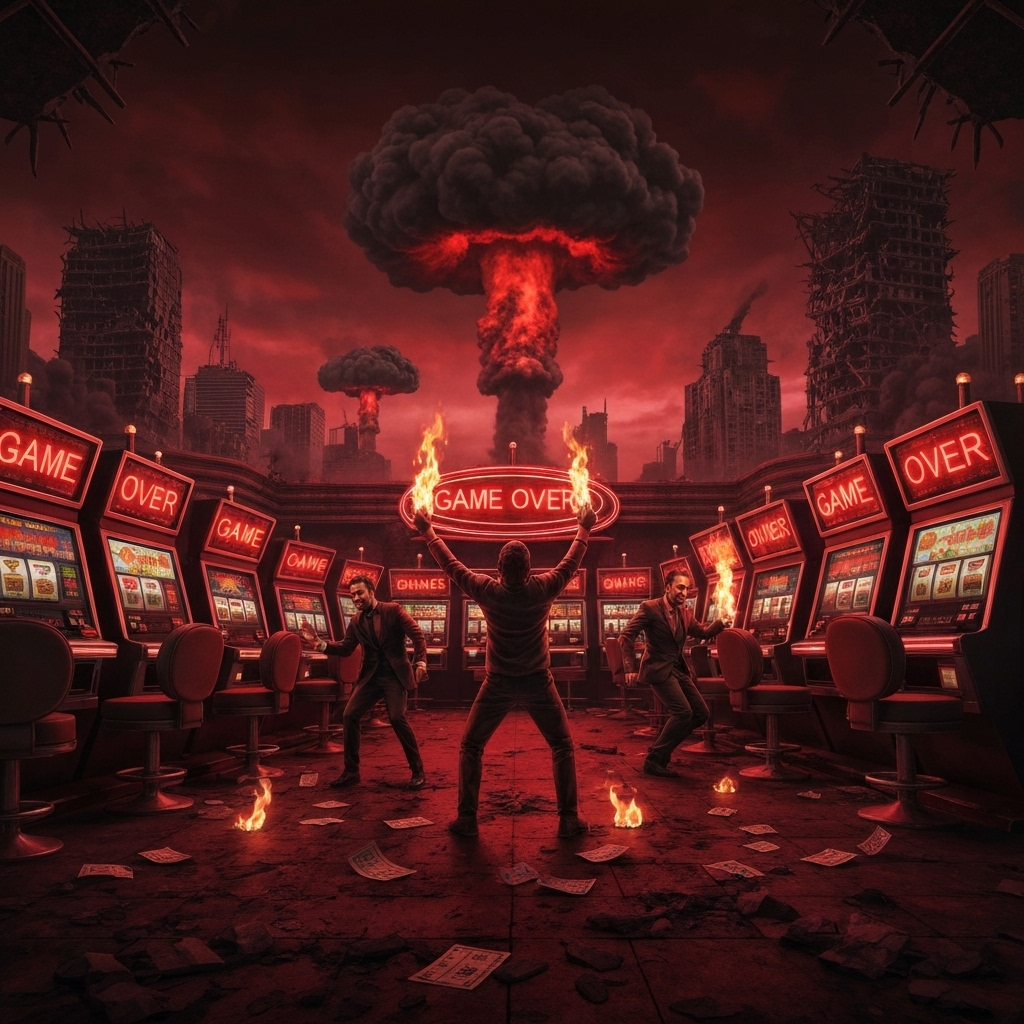
The Final Wager
From the Book of Revelation to Mad Max, humans have fantasized about the end of the world. Apocalyptic imagery saturates religion, cinema, politics, and even memes. Yet when it comes to bookmakers, the apocalypse is conspicuously absent.
You can bet on football. You can bet on elections. You can even bet on alien life. But walk into a betting shop and ask: “Can I put €50 on the world ending before 2050?” and you’ll be laughed out of the room.
Why? On the surface, it seems simple: the apocalypse is binary — either it happens or it doesn’t. But the deeper you dig, the clearer it becomes: apocalypse betting is where probability, ethics, and finance collapse.
This article examines apocalypse betting from multiple angles: statistical, legal, ethical, and philosophical. We’ll see why extinction is unbettable — and why that fact itself tells us something profound about human culture.
2. Probability Theory Meets the End of the World
Gambling requires resolvable probability spaces. Toss a coin → two outcomes. Roll a die → six outcomes. Bet on a football match → finite possible scores.
But how do you define probabilities for the apocalypse?
Empirical frequencies? Useless: the Earth hasn’t ended before.
Bayesian priors? Meaningless without data.
Subjective estimates? Philosopher Nick Bostrom’s existential risk estimates (e.g. 1-in-6 chance of extinction this century) are not verifiable.
In statistics, this is called a non-ergodic system: outcomes cannot be repeated to calibrate probability. Betting thrives on repeatable events. Extinction happens once, forever.
In other words: probability collapses under totality.
3. Game Theory: The Payoff Problem
In gambling theory, a bet has payoff structures. Win or lose, someone collects. But apocalypse bets face a fatal paradox:
If the apocalypse occurs, there are no survivors to collect payouts.
If it does not occur, all bets expire unpaid.
This breaks what economists call contract enforceability. A bet without possible settlement is a paradoxical contract — logically void.
Some philosophers call this a “Pascal’s Wager inversion.” Like betting on God’s existence, betting on extinction creates outcomes where no payoff is meaningful.
4. Moral Hazard: Incentivizing Doom
In economics, moral hazard describes situations where risk-taking is incentivized by external protection. In apocalypse betting, moral hazard is catastrophic.
Imagine:
A terrorist organization bets heavily on “Apocalypse before 2030.”
They then attempt to trigger nuclear war.
This transforms gambling from entertainment into an incentive for annihilation. Regulators outlaw any market that could encourage catastrophic behavior.
This is why assassination markets (illegal prediction markets on individuals’ deaths) are already banned. Apocalypse betting is their global version.
5. Historical Analogues: Doom Predictions as Pseudo-Markets
While no official apocalypse bets exist, cultures have run informal pseudo-markets:
Religious prophecy pools. In medieval Europe, peasants speculated on Judgment Day dates.
2012 Mayan apocalypse. Internet forums mocked or half-seriously “bet” on survival.
Y2K bug. Financial markets effectively acted as bets on collapse.
Each of these highlights why formal betting fails: once an apocalypse deadline passes, people laugh at failed prophets. But no money changes hands — because no regulator dares monetize human extinction.
6. Insurance vs. Apocalypse Bets
Insurance often mirrors gambling. You pay premiums; insurers pay if disaster strikes. There are policies for earthquakes, floods, pandemics. But nuclear war and apocalypse are universally excluded.
Why? Because insurance requires survivors to pay claims. Extinction leaves no market, no insurers, no regulators. It’s uninsurable by definition.
This demonstrates the line: gambling and insurance thrive only where damage is partial, recoverable, and bounded. The apocalypse is total, irreversible, and unbounded.
7. Sociology of Apocalypse Betting
Why do people want apocalypse bets? Cultural sociology suggests three reasons:
Dramaturgy: People want to participate in big narratives. Betting makes them part of the story.
Coping mechanism: Laughing at doom through wagers trivializes existential dread.
Speculation addiction: Apocalypse is the “biggest possible jackpot” — infinite stakes.
But societies reject monetization of shared dread. Bookmakers rely on spectacle, not trauma. Apocalypse betting would feel obscene, like profiting from genocide.
8. Legal and Regulatory Barriers
Most gambling laws require:
Clear outcome.
Independent verification.
Enforceable contracts.
Apocalypse bets fail all three. In addition, regulators fear:
Public outrage (“Bookies profit from Armageddon”).
Terrorist incentives (moral hazard).
Financial instability (mass bankruptcies if markets misprice risk).
Thus, apocalypse bets aren’t just illegal — they’re structurally impossible.
9. Existential Risk Studies: The Academic Angle
In philosophy, existential risk studies (Bostrom, Ord, Yudkowsky) attempt to quantify doomsday scenarios:
Nuclear war.
Superintelligent AI.
Asteroid impact.
Climate collapse.
These studies assign probabilities. For example, Toby Ord’s The Precipice estimates a 1-in-6 chance of extinction this century.
But crucially: these numbers are not odds. They’re heuristics for policymaking, not markets. Attempting to convert them into betting lines misunderstands their purpose.
10. Thought Experiment: If Apocalypse Bets Existed
Imagine tomorrow a crypto platform launched “Apocalypse Odds.”
Market: “Human extinction by 2100 — 500/1.”
Resolution: Determined by blockchain oracle.
Payout: Survivors only.
Immediately, paradoxes emerge:
Survivors may not exist.
Oracles cannot verify extinction.
Cheating and insider “false flag” risks abound.
The platform collapses under absurdity.
11. Comparisons: Permissible Catastrophe Bets
Bookmakers do allow bets on large-scale risks:
Alien discovery.
Climate events (e.g., “hottest year on record”).
Sports disruptions (COVID cancellations).
But these differ from apocalypse: they’re partial disasters. Apocalypse wipes out the bettor, bookmaker, and regulator alike.
12. Philosophical Reflections: Gambling as Proxy for Control
Why does apocalypse betting fascinate? Because it represents the ultimate attempt to control uncertainty. By turning extinction into odds, humans try to domesticate dread.
But gambling requires hope — the idea that you might win. Apocalypse bets remove hope entirely. They’re anti-games, black holes of play.
This reveals a deeper truth: gambling isn’t about chance; it’s about narrative continuity. The apocalypse ends all narratives, therefore all gambling.
13. Conclusion: The Unbettable End
You will never see apocalypse betting slip into mainstream sportsbooks. Not because regulators are squeamish, but because apocalypse destroys the foundations of probability, law, and narrative.
It is the anti-bet — too total to monetize, too final to play with.
The closest thing we have are cultural doomsday memes, dark humor, and existential philosophy. The apocalypse is unbettable because it is beyond spectacle, beyond insurance, beyond markets. It is the one game where, if it happens, the casino burns with the players.
❓ FAQ
Q1: Have apocalypse bets ever existed?
Not formally. Some novelty sites joked about 2012 or Y2K, but no regulated bookmaker allows it.
Q2: Why is apocalypse betting different from asteroid impact bets?
Because asteroid impacts can be partial (regional). Apocalypse implies total extinction, leaving no survivors to settle bets.
Q3: Could crypto markets allow it?
They could host the contracts, but no resolution mechanism exists for extinction.
Q4: Why won’t insurance cover apocalypse?
Because it requires payouts, and extinction leaves no survivors.
Q5: What does this reveal about gambling itself?
That gambling depends on continuity of society. The apocalypse breaks continuity, making gambling impossible.
About the author
My name is Hans & I'm a blue belt in Jiu Jitsu, train weight lifting since a few years whenever I get too fat and recently started to work as a Business Consultant in the supplements industry where I fell in love with natural testosterone boosters, fat burners etc. Turkester.ONE is my little baby and hopefully will become its very own brand soon enough! Until then, I keep reviewing third party products.


